- Weekly AI Marketing Brief
- Posts
- Solution to Slop: Strategy Over Speed
Solution to Slop: Strategy Over Speed
88% Are Spending More on AI. Only 1% Can Prove It's Working.

Lisa Peyton
January 29, 2026
Why is most AI-generated marketing content so bad? I hear this all the time, and honestly? Anyone who truly gets strategy and has put real time into AI tools would never ask it. The people who don't ask have witnessed AI alchemy – that moment when deep context meets the right toolset and pure magic happens. But most teams? They're drowning in mediocre output, caught between mandates to "use AI" and pressure not to produce garbage.
This isn't a tools problem. It's an AI literacy crisis, accelerated by adoption rates that have outpaced education.
🔥 This Week's Hot Takes: AI Marketing Edition
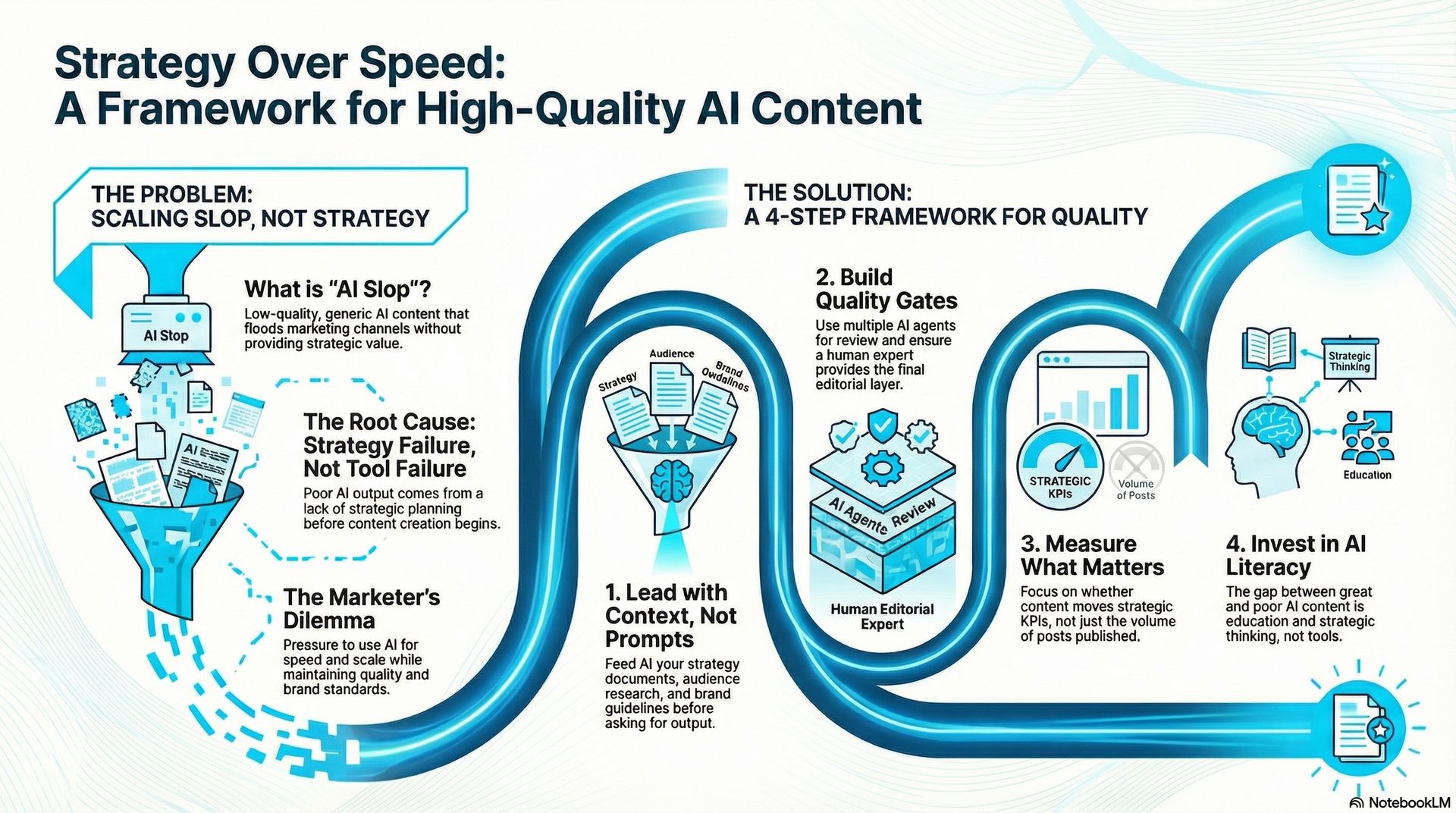
Scaling Without Slop: The Quality-at-Scale Framework (Lisa Peyton) – AI use at work jumped from 21% to nearly 50% by late 2025, but speed without strategy just creates slop at scale. The breakthrough insight? Before you open ChatGPT, answer this: What's the exact task, the specific output, and the strategic objective? Marketers winning with AI lead with context (not prompts), build quality gates into workflows, and measure
what actually matters.
NotebookLM's Secret Weapon: Style Prompting (Lisa Peyton) – Most marketers stop at default prompts and wonder why their NotebookLM visuals look generic. The game-changer? Layer your prompts like a design brief - tone, color palettes, typography specs, visual elements.
Management is AI's New Superpower (One Useful Thing) – Ethan Mollick challenged MBA students to build startups in four days using AI tools. The results? An order of magnitude further along than full-semester pre-AI work. The secret wasn't coding—it was management skills. Delegation, clear goal-setting, and evaluation expertise matter more
than ever.
AI Workplace Adoption Hits Critical Mass (AP News) – Gallup's workforce survey shows AI use at work jumped from 21% in 2023 to nearly 50% by late 2025, with 12% using it daily. The practitioner squeeze is real: use the tools, move faster, scale production—but somehow maintain quality, strategic alignment, and audience connection without additional budget.
Apple + Google: Siri Gets Serious (Finally) (9to5Mac) – Apple will unveil results of its Google Gemini partnership as soon as February 2026 with iOS 26.4 beta. After struggling with its own model development, Apple tapped Google's Gemini (1.2 trillion parameter model) to power new Siri features via Private Cloud Compute. Siri will finally be more context-aware, know more about you, and take actions in apps—something we've been saying is "coming soon" forever.
The War on Slop Goes Mainstream (Latent Space) – AI developer
swyx declared "War on Slop" at the AI Engineer conference, and the
term hit Merriam-Webster and The Economist as word of the year. The central
problem isn't eliminating AI—it's "changing the slope of slop." The AI
Engineer conference scaled from one event to seven globally, 10x'ed viewership,
AND improved quality. The formula? Strategic curation combined with tactical
discipline.
LLMs Are Rewriting Brand Perception (Harvard Business Review) – Two-thirds of Gen Zers and over half of Millennials now use LLMs to research products. When Pernod Ricard analyzed how AI models represented their liquor brands, they were dismayed: data was incomplete or incorrect. One AI model miscategorized Ballantine's Scotch (affordable mass-market) as a prestige product. Brands that don't actively manage their AI representation will lose control of their positioning.
AI Governance Without Strategy = Theater (MarTech) – 76.6% of marketers now have AI policies (up from 55.3% a year ago), but 71.6% haven't established ROI targets for AI investments. This is governance theater—policies without planning, boundaries without destinations. Organizations are building guardrails around a road that hasn't been mapped.
Chrome Goes Full Agent Mode (TechCrunch) – Google Chrome is getting tighter Gemini integration with agentic features for autonomous tasks, taking on AI-first browsers. This signals the mainstream arrival of agents that can browse, research, and complete multi-step tasks without constant human oversight.
AI Darwinism Has Arrived (Forbes CMO) – We're entering an age where the gap between AI-literate companies and those still figuring it out will become nearly impossible to close. Not because of better tools, but because of better strategy and AI
literacy to execute it.
AI-Generated Ads Face Trust Crisis (The Verge) – As AI slop floods advertising channels, platforms are investing Super Bowl-level budgets in brand ads to combat the trust problem. The authenticity crisis is forcing a reckoning about what role AI should play
in creative work.
🧪 The Alchemist's Lab:
Tools I've Been Testing
ChartGen AI – AI-powered chart generator that transforms data into professional
visualizations in seconds. Upload CSV/Excel, describe what you want in plain
English, and the AI creates bar charts, line charts, pie charts, scatter plots,
and more. Marketing Application: Perfect for turning campaign data into
client-ready reports, quarterly reviews, and presentation decks without
wrestling with Excel formatting. Supports 12 professional color themes and
natural language queries. Pricing: Free tier with 50 charts/month;
premium plans available.
Piktochart Generative AI – AI-enhanced infographic and visual content creation
platform. Combines template-based design with generative AI to create branded
visual content at scale. Marketing Application: Ideal for social media
graphics, presentation slides, reports, and infographics that maintain brand
consistency while leveraging AI speed. Pricing: Tiered pricing model
available on site.
(*While these tools are always worth testing, I’m still coming back to Claude for my charts and graphs – better output in less time.)
🎓 AI Marketing Master Class Moment
Recommended or Rejected: Does AI Trust You (From Social Media Examiner)
Watch on YouTube
This video explores why visibility in AI results matters
critically to marketers and business owners. As consumers increasingly use LLMs
to research products and make purchasing decisions, your brand's representation
in AI outputs directly impacts discoverability and revenue. The practical
application? If AI models are miscategorizing your products (like calling an
affordable whiskey "prestige") or omitting your brand entirely from
research results, you're losing customers before they even know you exist. Learn
how to audit your brand's AI visibility, correct inaccurate representations,
and ensure your strategic positioning translates accurately when AI agents make
recommendations to potential customers.
📊 The Number That Made Me Spill My Green Tea
1.1%
That's the percentage of marketing organizations that achieve both high measurement sophistication AND high ROI expectations for their AI investments.
Think about that. Nearly 90% plan to increase AI spending, 76.6% have governance policies in place, but only 1 in 100 can actually connect investment to outcomes. This isn't a technology problem—it's a systems failure. Organizations are deploying AI tools, establishing usage policies, and forming oversight committees all while lacking the fundamental capability to measure whether any of it works.
🥊 Battle of the Week: Governance First vs. Strategy First
Team Governance First argues that with 95.5% of
marketers worried about compliance and data privacy, you need policies in place
before wide AI adoption. Establish guardrails, form cross-functional
committees, document acceptable use cases. Protect the organization first, optimize
later.
Team Strategy First counters that governance without
strategy creates control theater, not value. You're building beautiful
guardrails around a road that doesn't exist yet. The 71.6% who lack ROI targets
and 46.2% without formal AI planning horizons prove that policies alone don't
drive outcomes.
My Verdict: Strategy. First. Always.
Governance is critical, don't misunderstand me. But
governance serves strategy, never the reverse. The sequence matters. Planning
horizons → ROI targets → strategic roadmap → THEN governance framework.
Otherwise you're just creating bureaucracy that slows adoption without
improving outcomes. The 1.1% who got this right didn't start with policies.
They started with clarity about what winning looks like, then built systems to
protect and scale those wins.
Before You Go: Hit reply and tell me - what's your biggest AI marketing challenge right now? I read every response and it helps shape future newsletters!
That's a wrap on this week's AI marketing alchemy! Keep experimenting, keep transforming, and remember - true magic happens when we blend AI efficiency with human creativity.
Crafted with passion (and a dash of AI alchemy) by Lisa Peyton | AI Marketer, Professor, and Innovator
Let's connect in the digital realm: https://linktr.ee/lisapeyton
🎯 Want a single place to find practical AI help for your marketing work?
I put together a hub of resources that can support you at every stage. Take a look here for tools and learning that can help sharpen your AI marketing practice: https://lisapeyton.com/ai-marketing-resources/