- Weekly AI Marketing Brief
- Posts
- The Upstream Advantage
The Upstream Advantage
Why the smartest marketing teams are done using AI to make more content and are using it to make better decisions.

Lisa Peyton
January 22, 2026
Across its generative AI research, McKinsey has consistently shown that sales and marketing represent one of the largest pools of AI-driven economic value - outpacing most other business functions. And yet employee sentiment around AI use is lagging. That gap tells us something important. It's not that AI lacks power. It's that too many teams are still using it to create more content, faster, while the real value lives upstream. Think competitive intelligence that anticipates market shifts, customer research completed in hours instead of months, and strategy that evolves in real time.
I see this often in my work with marketing teams and in the classroom. Before my students create anything, they have to answer three deceptively simple questions: What is the role of this content? Who is it for? And what do you want the audience to do or feel after engaging with it? As AI becomes better and better at generating outputs, those questions are no longer optional. They are the strategy. If you can't answer them clearly, acceleration just produces noise faster.
That's why this week's research matters. It confirms what seasoned practitioners already sense: the tactical layer we're automating today is the lowest-value use of AI. The real advantage comes from moving up the stack, from execution to direction-setting. With that frame in mind, here's what actually matters from this week's AI developments and how leading teams are using them to guide the work, not just produce it.
🔥 This Week's Hot Takes: AI Marketing Edition
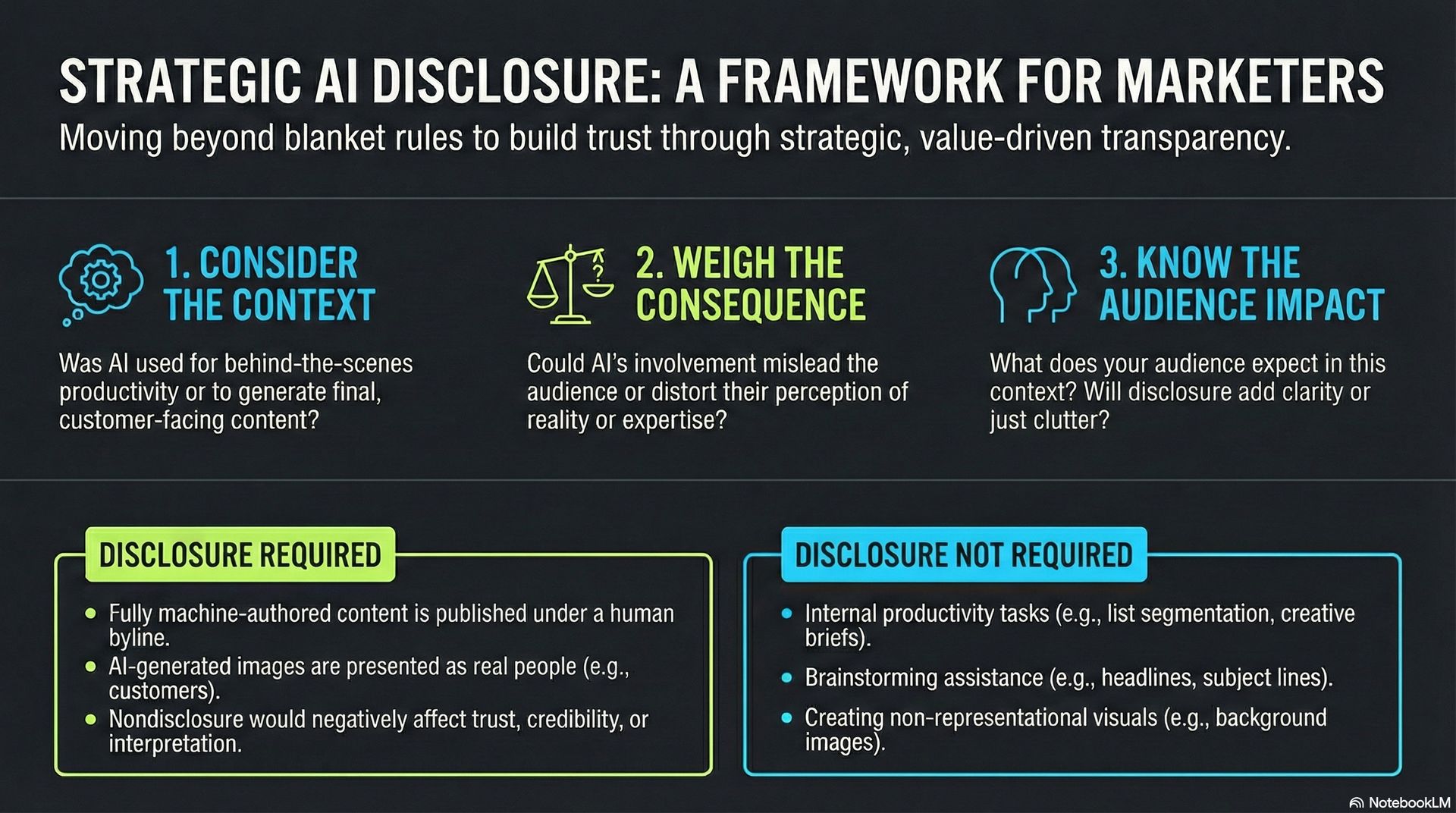
Crafted using NotebookLM and Jeanne Jennings MarTech article below.
A Practical Framework for AI Disclosure in Marketing (MarTech) – Context, consequence, and audience impact should guide AI disclosure decisions, not blanket rules. Jeanne Jennings argues we need a continuum model: disclosure matters when AI's involvement could mislead or distort perception, not when it's just speeding up internal workflows. Full AI-generated content passed off as original? Disclose it. Subject line brainstorming? That's like kicking ideas around with a colleague.
Superagency in the Workplace: Empowering People to Unlock AI's Full Potential (McKinsey) – McKinsey's massive study reveals employees are 3x more likely than leaders expect to be using gen AI for 30% of their daily work. The barrier to AI maturity isn't employees (who are ready) but leaders who aren't steering fast enough. Only 1% of companies have reached AI maturity despite 92% planning to increase investments. Nearly half of employees want formal training, but 22% report receiving minimal to no support.
OpenAI’s Approach to Advertising and Expanding Access (OpenAI) – OpenAI is testing ads in ChatGPT's free and Go tiers to expand access while promising ads won't influence answers, conversations stay private, and they'll never sell user data. ChatGPT Go (now $8/month globally) sits between free and Plus, offering expanded access to messaging, image creation, and memory. Pro, Business, and Enterprise remain ad-free.
OpenAI Hits $20B in Revenue (With A $17B Problem) (The Neuron) – OpenAI reached $20B annualized revenue (233% growth), but will burn through $17B in 2026. The company is essentially selling $10 bills for $4, betting that future efficiency gains will flip the equation.
Google VP Says Ads Aren't Coming to Gemini Yet—Why (Business Insider) – Google's Dan Taylor publicly denied reports that Gemini would get ads in 2026, stating "there are no ads in the Gemini app and there are no current plans to change that." The denial came after Adweek reported Google briefed advertisers on 2026 ad rollout plans. Google DeepMind CEO Demis Hassabis found it "interesting" that ChatGPT opted for ads "so early," suggesting maybe they "feel they need to make more revenue."
Allie K. Miller’s Favorite AI Tools and Tips for Each Task - January 2026 Edition (AI with Allie) – Allie's monthly roundup covers her current go-to AI tools for research, writing, image generation, video editing, and more. A practical resource for marketers looking to stay current on which tools actually deliver in daily workflows.
AI is Paying Off for B2B Marketing. For B2B Marketers? Not So Much. (MarTech) – AI is cutting costs and boosting productivity for B2B marketing teams, but many B2B marketers say AI skills haven't helped their paycheck. According to Metadata.io's survey, 90% of tech marketers use AI daily, yet only 4.7% say those skills led to a raise or promotion.
AI Email Marketing Best Practice and Advice (Marketing Technology News) – Best practices for using AI in email marketing campaigns, from personalization to optimization. The piece covers how to leverage AI while maintaining authentic brand voice and avoiding the "AI slop" trap.
How Digital Marketing Agencies Are Adapting to AI Search (Search Engine Land) – Agencies are shifting from keyword-driven SEO to contextual authority that AI search engines cite. The focus: becoming the trusted source that tools like ChatGPT, Perplexity, and Google's AI Overviews reference when answering user queries.
A Multi-Model World: Microsoft's CEO Says the Future of AI is Orchestration, Not One Single Model (Digiday) – Microsoft's Satya Nadella argues the future isn't about finding the "one perfect AI" but orchestrating multiple models for different tasks. This multi-model approach means marketers will need to become skilled at choosing and combining models rather than pledging allegiance to a single platform.
🧪 The Alchemist's Lab: Tools I've Been Testing
Rival IQ – A competitive intelligence platform that tracks social media performance, content strategy, and digital marketing metrics across your competitors. For AI marketing applications: Use it to inform upstream strategy rather than just benchmarking vanity metrics. The real value is identifying content gaps and market positioning opportunities before you ever open ChatGPT to create something. Pricing varies based on features and company size.
💼 Industry Moves & Grooves
The Ad Revenue Race – OpenAI is testing ads while Google insists Gemini stays ad-free. The contrast reveals different approaches to monetization: OpenAI needs revenue to offset massive compute costs, while Google can afford patience because its existing search ads already subsidize AI development. The winner might be whoever cracks sustainable economics first without destroying user trust.
The Training Gap – Employees are ready to use AI more extensively, but 48% of workers rank training as the most important factor for adoption while 22% report receiving minimal to no support. This disconnect between worker readiness and organizational support represents a massive opportunity for companies willing to invest in structured AI training programs.
The Profitability Paradox – AI is increasing B2B marketing efficiency and productivity, but those gains aren't reaching individual marketers' paychecks. This suggests companies are capturing AI productivity gains as margin improvement rather than sharing it with employees who develop these skills. Expect this tension to escalate as AI skills become table stakes rather than differentiators.
🎓 AI Marketing Master Class Moment
Claude Code for Absolute Beginners: STEP-BY-STEP TUTORIAL Watch on YouTube
This tutorial walks through Claude Code from first principles—no prior coding experience required. For marketers, this represents the shift from "using AI to write copy" to "using AI to build custom tools that solve your specific workflow problems." The practical application: instead of paying $50/month for yet another martech subscription, you can build exactly what you need. Whether or not you take that path, understanding what's possible changes how you evaluate and negotiate with vendors.
🤖 AI Whispers (That You'll Want to Shout About)
The vibe-coding revolution isn't just about hobbyists building weekend projects. It's about power shifting from vendors to practitioners. When employees can build good-enough internal tools faster than procurement can approve new software, every SaaS company becomes vulnerable. But here's the nuance most miss: enterprise software survives not because of superior technology but because of accountability, compliance, and someone to call at 3am when things break. The real disruption isn't technical - it's cultural. Teams developing the "build vs. buy" muscle will fundamentally change how they evaluate marketing technology, and vendors who don't adapt their value propositions beyond "we have features" will struggle.
🏆 My Take: What This Means for Your Marketing
The ONE thing: Stop using AI to make more stuff. Start using AI to figure out what stuff is actually worth making.
McKinsey's research confirms what we're seeing in practice: the highest-value AI applications aren't in content generation—they're in competitive intelligence, customer research, and strategic planning. The marketers winning right now are using AI to compress three months of market analysis into three days, then using human judgment to decide what to do with those insights.
Your immediate action: This week, before you use AI to create anything, use it to answer these three questions about your next campaign: (1) What strategic insight do we need before we create content? (2) What are our competitors doing that we're not seeing? (3) What do our customers actually care about right now, not what we assume they care about? Use AI to research first, strategize second, and create last - not the other way around.
📊 The Number That Made Me Spill My Green Tea
72% – That's how often GPT-5.2 produces work that matches human expert quality on the first pass, up from just 39% for GPT-5. This isn't incremental improvement; it's the difference between "AI as assistant" and "AI as colleague." At 39%, you're still doing most of the work. At 72%, delegation becomes your default.
🥊 Battle of the Week: Free AI With Ads vs. Paid AI Without
OpenAI is betting users will tolerate ads to access ChatGPT for free or $8/month. Google is betting Gemini stays cleaner by remaining ad-free while monetizing through search. Who wins?
The OpenAI case: Ads fund accessibility. More users get powerful AI tools without high subscription costs. The risk: ads erode trust right when trust matters most for AI adoption.
The Google case: Ad-free Gemini protects user experience while Google subsidizes development through its existing search advertising monopoly. The risk: competitors who monetize directly from AI users move faster and iterate on advertising without Google's baggage.
My verdict: This isn't really about ads - it's about which companies can afford to play the long game (ummm…GOOGLE!). Google can keep Gemini ad-free because Search prints money. OpenAI needs every revenue stream it can get to justify its burn rate. Neither approach is inherently better; it's about matching business model to competitive position. The real winners will be marketers who understand how each platform's monetization model affects algorithm behavior and answer quality. Because make no mistake: when ads arrive, the incentives change, and so will the outputs.
Before You Go: Hit reply and tell me - what's your biggest AI marketing challenge right now? I read every response and it helps shape future newsletters!
That's a wrap on this week's AI marketing alchemy! Keep experimenting, keep transforming, and remember - true magic happens when we blend AI efficiency with human creativity.
Crafted with passion (and a dash of AI alchemy) by Lisa Peyton | AI Marketer, Professor, and Innovator
Let's connect in the digital realm: https://linktr.ee/lisapeyton
🎯 Need a single place for practical AI marketing help?
If you want a single place to find practical AI help for your marketing work, I put together a hub of resources that can support you at every stage. Take a look here for tools and learning that can help sharpen your AI marketing practice: https://lisapeyton.com/ai-marketing-resources/